Saturday, April 29, 2006

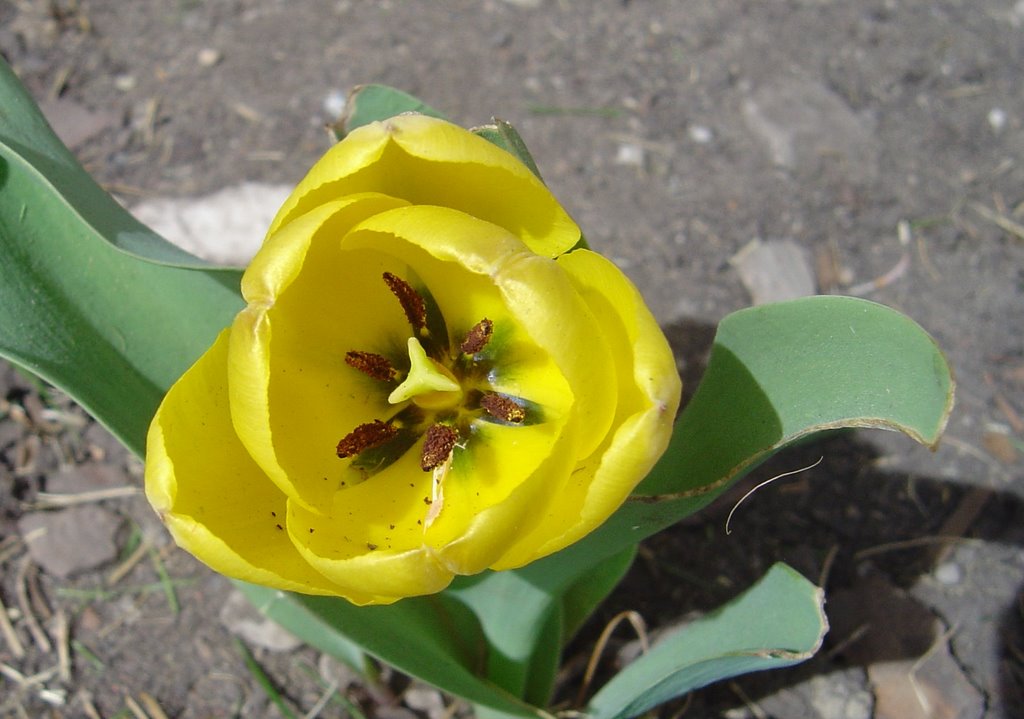
first flower

Yesterday evening I could see a bud straining to break forth and this morning there it was, more full than I would have anticipated. The first flower of the season, the first tulip of spring.

Perhaps it is timely that a tulip, the national flower of Iran, peacefully came forth just as tensions seem to be rising in that part of the world. Whatever happens regarding Iran and its nuclear aspirations at least I can depend on this tulip appearing regularly each year.

Oh! how the world is wasted on man.


For more information ...
go out and smell a flower

Friday, April 28, 2006

varietals - merlot

Think of merlot as cabernet sauvignon's younger brother. It shares some of the fruit characteristics and additionally has plummy and even chocolate notes but without the robustness of cabs. Unfortunately whilst cabernet may be the tough elder brother, merlot sometimes comes off as a weakling. This stereotype was regrettably reinforced by the movie 'sideways', I say regrettably because good merlot has a distinct character worth exploration.

As with cabernet sauvignon, Bordeaux is the classic region producing quality merlots but also look for good merlots from the US (both California and Washington State). Chile also has good merlots to offer although some tend to be mislabelled and in truth are carmenere (source: the wine bible). Australia too has some good merlot and often blend it with cabernet sauvignon, as do other regions.


I refreshed my memory of merlots by opening a bottle of 2003 Ravenswoods from Sonoma County, California. This 100% merlot is produced by Joel Peterson, a winemaker who prides himself on creating merlots with character. Although Ravenswood is owned by the mega-corp Constellation, don't let that put you off trying this wine.

Strong black fruit , I could not detect chocolate or mocha. Perhaps a little plum. Certainly it was quite robust , medium to full bodied. The tannins perhaps lend some character but their bitterness resulted in the loss of a soft, velvety quality I had been looking for. There was some spice, not quite pepper perhaps clove. I hesitate to criticize this wine, it has tried to be something more than a weak and meek merlot, but in the end I just did not enjoy it. It may be worth the $CAN20 (Euro14, $AUS24, UKP10) for some but I think I will not buy it again.

I feel like the mystery of a good merlot had not been revealed to me, so I expect to explore more soon. A Pomerol or that Bogle merlot that has been hanging around waiting for an occassion.

For more information ...
sideways
the wine bible
ravenswood merlot
constellation brands

Wednesday, April 19, 2006

the death of ivan ilyich

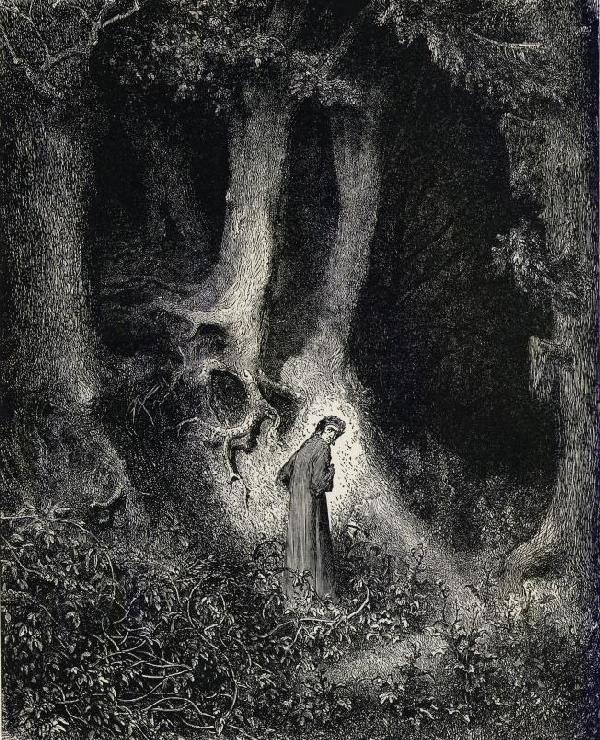
Illustration from The Divine Comedy by Gustave Dore

'What if my whole life has been wrong?'

It occurred to him that what had appeared perfectly impossible
before, namely that he had not spent his life as he should have
done, might after all be true. It occurred to him that his
scarcely perceptible attempts to struggle against what was
considered good by the most highly placed people, those scarcely
noticeable impulses which he had immediately suppressed, might have
been the real thing, and all the rest false. And his professional
duties and the whole arrangement of his life and of his family, and
all his social and official interests, might all have been false.
He tried to defend all those things to himself and suddenly felt
the weakness of what he was defending. There was nothing to
defend.

'But if that is so,' he said to himself, 'and I am leaving
this life with the consciousness that I have lost all that was
given me and it is impossible to rectify it -- what then?'

Extract from 'The death of Ivan Ilyich' by Leo Tolstoy, first published 1886.


I would encourage anyone to read this classic novella by Leo Tolstoy. It is both sobering and frightening in confronting the reader with the meaning of life, or lack thereof and yet at the end of its darkness is light.


For more information ...
tolstoy

Wednesday, April 12, 2006

cartaphilus

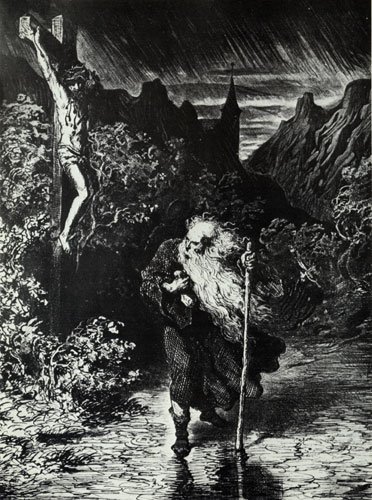
Medieval legend has it that as Jesus walked to Golgotha he was disrespected by a shoemaker amongst others. As a result of this disrespect, this man, (variously known as Cartaphilus, Malchus and Ahasverus) was cursed by Jesus to wander the earth forever.

The legend itself has many incarnations but seems to be European in origin. One of the incarnations relates that Cartaphilus wanders the earth until the age of 100 when he is miraculously changed back to a 30 year old and his wanderings begin again. Various 'sightings' have occurred throughout continental Europe, mostly in Austria, Germany and Switzerland.

The wandering Jew by Gustave Dore

The legend has obvious anti-Semitic overtones resulting from the crucifixion story and the prevailing attitudes towards Jews in medieval Europe. However, I feel there is something more to the legend. Perhaps it is the idea that contentment is unattainable for those who deny god and this discontent is demonstrated through meaningless meanderings. Again, parallels with the Jewish diaspora can be drawn but for me I see in this legend a more personal perspective. I don't believe in god so you can understand how I might be perturbed if contentment is out of my reach. I also have done my fair share of wandering and sometimes it does seem to be without meaning.

The Incredulity of Saint Thomas by Caravaggio

Am I Cartaphilus, reanimated for purposeless perennial perambulation? Perhaps? Or is this wandering how us unbelievers discover the world for ourselves rather than accept what is presented to us in a book or by a priest?

Like Doubting Thomas perhaps Cartaphilus is guilty of wanting to find out about the world for himself. For Thomas it was instigated by doubt, for Cartaphilus it was instigated by a curse but are both men not wiser?

Can their be contentment in ignorance? I think not. The journey will be long and winding but I have two feet and a brain, I say 'let's begin walking'. Will you walk with me?


For more information ...
wandering jew
doubting thomas

Wednesday, April 05, 2006

winter picks

Those of you who were concerned for my liver after reading my fall picks can now rest easy as this past winter saw moderate imbibing. I sampled 16 new wines and was surprised that 9 of those were whites as I thought the cold winter months might see me crack open more reds. I mostly tried French and Spanish wines but also managed to quaff a few from the US and Australia also.

I have only three recommendations from my tastings.

1. Twenty Bench, Cabernet Sauvignon, 2003 - Napa Valley, California, USA (17/20)
"fruity, cedar, smoky but not overpowering", for more tasting notes look here

2. Abrazo Gran Reserva, Carinena, Garnacha, Tempranillo, 1996 - Spain (16/20)
"more full bodied that the regular Abrazo, different but also good"

3. Hillside Estate, Reserve Series, Muscat Ottonel, 2004 - Okanagan, Canada (16/20)
"a different grape, peachy, citrus, orange, slightly fizzy, sweet and nice"

So nothing from France made my recommendations although an Alsace wine (Pierre Sparr, 0ne, 2004) came close. I was really impressed with the Twenty Bench but at $25 (17EURO, 12UKP, $AUS29) I would say it was a little expensive for everyday indulgence.

The regular Abrazo made my fall list and so it is no surprise to me the Gran Reserva made this list. The Gran Reserva has tempranillo whereas the regular Abrazo has not, I felt it was more full bodied but I am not sure this is due to the tempranillo.

Finally the inclusion of a Canadian wine is no 'sympathy vote', the wines from Hillside Estate are very good and this wine is very different from other wines I have tried. We picked it up whilst visiting the vineyard a couple of years ago so unfortunately it is probably quite hard to come by even in Canada.

I expect for Spring I will drink more US wines. Good Australian wine continues to elude me, getting a corked Wolf Blass Sauvignon Blanc recently did not help their reputation but I am a forgiving-sort so I expect I will give them a try again. Hic!

For more information ...
twenty bench
abrazo gran reserve
hillside estate

Sunday, April 02, 2006

to a butterfly

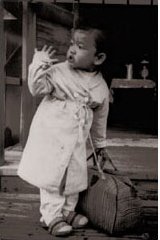
lani morioka walking to group showers in a US WWII internment camp

I've watched you now a full half-hour;
Self-poised upon that yellow flower
And, little Butterfly! indeed
I know not if you sleep or feed.
How motionless!--not frozen seas
More motionless! and then
What joy awaits you, when the breeze
Hath found you out among the trees,
And calls you forth again!

This plot of orchard-ground is ours;
My trees they are, my Sister's flowers;
Here rest your wings when they are weary;
Here lodge as in a sanctuary!
Come often to us, fear no wrong;
Sit near us on the bough!
We'll talk of sunshine and of song,
And summer days, when we were young;
Sweet childish days, that were as long
As twenty days are now.

Stay near me--do not take thy flight!
A little longer stay in sight!
Much converse do I find in thee,
Historian of my infancy!
Float near me; do not yet depart!
Dead times revive in thee:
Thou bring'st, gay creature as thou art!
A solemn image to my heart,
My father's family!

Oh! pleasant, pleasant were the days,
The time, when, in our childish plays,
My sister Emmeline and I
Together chased the butterfly!
A very hunter did I rush
Upon the prey:--with leaps and springs
I followed on from brake to bush;
But she, God love her, feared to brush
The dust from off its wings.

William Wordsworth, 1801 (1770-1850)


This is yet another poem from my son's nursery rhyme collection. In that book just the first two verses are given but from them I figured that this was not just another pantheist hymn of Wordsworths. A quick internet search revealed the last two verses and from them we see hints of a more personal story.

Wordsworth lost his mother when he was eight and was sent to school, away from his beloved sister Dorothy who was six at the time. Five years later their father died. William and his sister had a close attachment from an early age which they were able to renew in later years. From 1799 to 1813 they shared a house in the lake district and this poem was written during that particularly creative period. Unfortunately Dorothy who was sensitive as a child spent the last twenty years of her life suffering with mental illness.

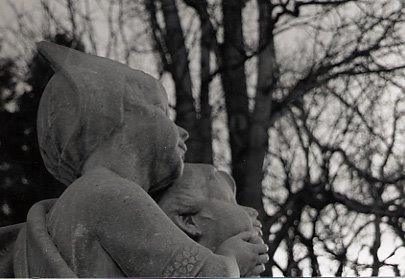
The poem perhaps gives us a glimpse of happy times the siblings spent together. Like much lyric poetry I feel this poem is meant to be sung. I have sung it to my boy for the past three weeks and the musical quality come through each time. The photo seemed to capture some of the childhood innocence and also the separation the poem evokes.

For more information ...
william wordsworth
june utako morioko

Tuesday, March 28, 2006

peek and boo discuss optimism

Somewhere in this land. Rising light. Faint whistle of awakening birds. Two enter.

Peek: Ahh! Morning has broken, like the first morning.

Boo: Broken wind more like!

Peek: Ahh! Boo, you look at the world with such dark eyes.

Boo: My eyes are hardly open at this ungodly hour. If it weren't for that farmer and his spelt.

Peek: It is true we have to tend the fields but is not everything for the best, in this the best of all possible worlds?

Boo: You are sounding suspiciously French this morning, be gone with you and your chatter!

Peek: And isn't the morning beautiful and are we not lucky to have work so we can fill our bellies and gargle a draft or two?

Boo: I do my work, I eat my food and drink my beer, that is true.

Peek: There you go then, is it not a fine world we live in?

Boo (irritated): But what I do says little about the world, not that there is much to say.

Peek: But there is a whole world with so much going on and so much that could be changed, so that it could be better.

Boo: I do my work, I change my world, I cultivate my garden not my neighbours.

Peek: Ahh! I sense a Gallic soul beneath that Saxon skin.

Boo: My skin is hard from turning the sod, my soul, ..... well, I am not sure of what you speak.

Peek: Ahh! my lowly Boo, you are too modest, you are the philosopher king of the gleaners.

Boo: Christ! Peek, shut up. We have fields to tend, let's go.

Peek: Yes, let's go.

Rising light. A chorus of birds now fully awake. Two exit.


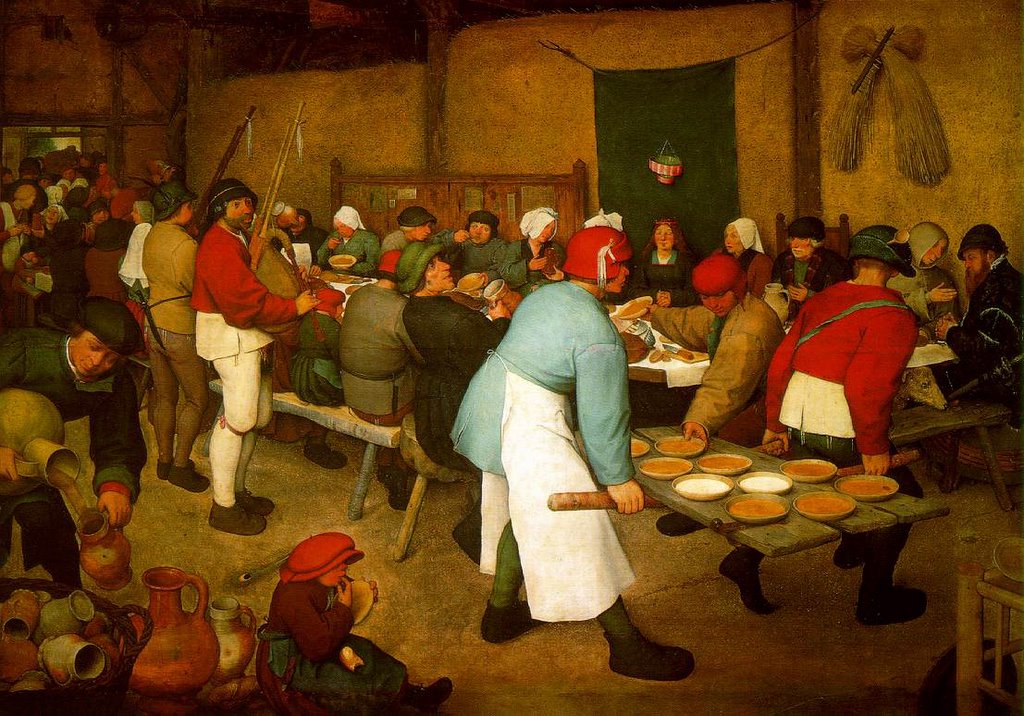
the gleaners, jean-francois millet, 1857

For more information ...
candide
peel and boo discuss the simple life
peek and boo discuss life and meaning
peek and boo discuss thought and action
peek and boo discuss existentialism
peek and boo discuss writing
peek and boo discuss god
peek and boo discuss power

Friday, March 17, 2006

big rock candy mountain


two okie children, circa 1935

One evening as the sun went down
And the jungle fires were burning,
Down the track came a hobo hiking,
And he said, "Boys, I'm not turning
I'm headed for a land that's far away
Besides the crystal fountains
So come with me, we'll go and see
The Big Rock Candy Mountains

In the Big Rock Candy Mountains,
There's a land that's fair and bright,
Where the handouts grow on bushes
And you sleep out every night.
Where the boxcars all are empty
And the sun shines every day
And the birds and the bees
And the cigarette trees
The lemonade springs
Where the bluebird sings
In the Big Rock Candy Mountains.

In the Big Rock Candy Mountains
All the cops have wooden legs
And the bulldogs all have rubber teeth
And the hens lay soft-boiled eggs
The farmers' trees are full of fruit
And the barns are full of hay
Oh I'm bound to go
Where there ain't no snow
Where the rain don't fall
The winds don't blow
In the Big Rock Candy Mountains.

In the Big Rock Candy Mountains
You never change your socks
And the little streams of alcohol
Come trickling down the rocks
The brakemen have to tip their hats
And the railway bulls are blind
There's a lake of stew
And of whiskey too
You can paddle all around it
In a big canoe
In the Big Rock Candy Mountains

In the Big Rock Candy Mountains,
The jails are made of tin.
And you can walk right out again,
As soon as you are in.
There ain't no short-handled shovels,
No axes, saws nor picks,
I'm bound to stay
Where you sleep all day,
Where they hung the jerk
That invented work
In the Big Rock Candy Mountains.
....
I'll see you all this coming fall
In the Big Rock Candy Mountains

- Harry McClintock, 1928

Although I don't believe in heaven, the song above, (popularised by the film 'O Brother, where art thou?') seems to evoke some of the pastoral simplicity many of us might look for in an earthly heaven.

I particularly like the line 'where the hung the jerk that invented work'. I have no big reason for posting this other than for people to read and wonder.

For more information ...
harry mcclintock
big rock candy mountain

Sunday, March 12, 2006

varietals - cabernet sauvignon

Bordeaux is the classic region offering cabernet sauvignon wines but I would also suggest trying Sassicaia from Tuscany, a South Australian and a Californian cab. Other regions including Chile and South Africa also produce cabernet sauvignon which is a hybrid between the cabernet franc and sauvignon blanc grapes.

My tasting often conforms the heavy tannins*, full body and fruitiness of this grape. The fruit is classically described as blackcurrant (cassis) and sometimes there is a vegetal hint of bell pepper (capsicum). This vegetal character may be present in wines where the grapes have not ripened to their optimum level, perhaps due to a cooler climate.

I definitely recommend decanting cabs as this will take a little off the tannin edge. Another common practice is for the winemaker to blend cab with another grape (merlot in France, shiraz in Australia) and this adds to the character of the wine and downplays the cabs robustness. That robustness helps cabs age and with age the tannins can diminish.


For this article I refreshed my memory and my palate by trying a cab from the Napa Valley, California. The 2003 Twenty Bench cabernet sauvignon displays a 'jammy' quality and has a hint of wood (cedar? oak?). I also detected spiciness (nowhere near as spicy as a Shiraz) and a smoky quality, perhaps that is the cedar? It was not as strong in tannins as I would have expected from a relatively young wine but that was a good thing. The tasting notes below allude to cherry and licorice but I did not pick up on these. I may be confusing the licorice with spiciness and the cherry with blackcurrant. Overall I enjoyed this bottle and even at $CAN25 (Euro18, $AUS29, UKP13) it was worth it.

* tannins - it is the skin and seeds of the grape that contribute the tannins to a red wine. To counteract this astringent quality, decant and aerate the wine or eat cheese. The fat in cheese counteracts tannins just as milk in tea does. (source: the wine bible)

For more information ...
the wine bible
twenty bench (tasting notes)

Saturday, March 04, 2006

cast a cold eye

The essence of stoicism is not (contrary to popular perception) about denial of emotions. Stoicism acknowledges that there are things within our control and things outside of our control. It acknowledges that thought can precede feelings and therefore that we can be the master of, rather than a slave to our emotions.

Stoicism is a difficult philosophy to live by, it can lead to a Spartan existence where the joys of life are not fully experienced but I find myself continually attracted by it. Although thankful of a recent work promotion I find myself not getting too excited by it as I understand that like all in this life, this too is transient.

I don't believe Yeats was a stoic yet when it came to his final words, he left us with a simple if not complete encapsulation of it.


For more information ...
w.b.yeats
sparta
stoicism

Tuesday, February 28, 2006

not an absurdist verse

@2004 courtesy of Keri S. Hathaway- Washington Park, Denver, Colorado

Wynken, Blynken, and Nod one night
Sailed off in a wooden shoe,--
Sailed on a river of misty light
Into a sea of dew.
"Where are you going, and what do you wish?"
The old moon asked the three.
"We have come to fish for the herring-fish
That live in this beautiful sea;
Nets of silver and gold have we,"
Said Wynken,
Blynken,
And Nod.

The old moon laughed and sung a song,
As they rocked in the wooden shoe;
And the wind that sped them all night long
Ruffled the waves of dew;
The little stars were the herring-fish
That lived in the beautiful sea.
"Now cast your nets wherever you wish,
But never afeard are we!"
So cried the stars to the fishermen three,
Wynken,
Blynken,
And Nod.

All night long their nets they threw
For the fish in the twinkling foam,
Then down from the sky came the wooden shoe,
Bringing the fishermen home;
'T was all so pretty a sail, it seemed
As if it could not be;
And some folk thought 't was a dream they'd dreamed
Of sailing that beautiful sea;
But I shall name you the fishermen three:
Wynken,
Blynken,
And Nod.

Wynken and Blynken are two little eyes,
And Nod is a little head,
And the wooden shoe that sailed the skies
Is a wee one's trundle-bed;
So shut your eyes while Mother sings
Of wonderful sights that be,
And you shall see the beautiful things
As you rock on the misty sea
Where the old shoe rocked the fishermen three,--
Wynken,
Blynken,
And Nod.

eugene field

The first verse of the above poem is printed in my son's nursery book and I thought that it was quite absurd. However looking on the web I found the full poem and upon reading it you can see the great fantasy provided is unravelled by the author.

I am a sucker for lyricism and this poem has a simple but attractive musical quality. I think the author does a disservice by exploding the myth he creates. Does he do this to satisfy the child listening or parent reading? Either way I think the poem ends flat. Symbolism is all well and good where meaning is important but surely meaning is secondary in this poem.

For more information ...
eugene field
absurdist verse

Saturday, February 18, 2006

absurdist verse

As I was going up the stair
I met a man who wasn't there.
He wasn't there again today -
Oh! how I wish he'd go away!

author unknown

Continuing in the series of poems from my son's nursery rhyme book, this is a great lyric example of absurdist verse. It presents an idea that defies reason but seems reasonable at the same time.

I think the truly absurd is not that which seems totally fantastic but that which fools us into thinking it may be reasonable and frustrates us in our search for reason.

For more information ...
absurdism
ozymandias

paradise lost - paradise regained III

Do we need to lose it all before we create a more fulfilled life?

The life of the emigrant can be one of losing home, losing culture, losing language and losing family. Most emigrants don't start with the intent of losing any of these but rather with the intent of gaining something else and yet a sense of loss often dominates emigrants lives.

At that point then, the emigrant is confronted by the 'myth of return', the propulsion to return home in an attempt to regain what was lost. Of course, everything has moved on, everything has changed and nothing of their 'old life' can be regained.

And so it remains for the emigrant to rediscover what it was they left home for, it remains for them to create what life they want.

Do we need to lose it all before we create a more fulfilled life? We either accept what life we have been born into or reject it and create something else.


For more information ...
paradise lost - paradise regained II
paradise lost - paradise regained I

Wednesday, February 15, 2006

word cloud


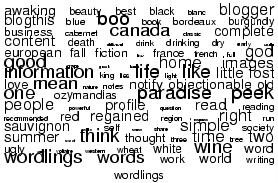
The word cloud above shows graphically the occurrence of words in my blog, more frequent words are bigger.


For more information ...
Try this with your site at http://www.snapshirts.com/custom.php

Tuesday, January 17, 2006

ugly chases beauty

Ugly chases Beauty through fields of deepening heather,
Ugly runs up hill, Beauty down.
Snow begins to fall.

Ugly grows tired as Beauty springs into the distance.
Ugly stops, Ugly lies alone.
Darkness closes in.

Melting away, signs of Beauty left behind,
Etched into earth, something to feel.
Ugly smiles and says.

'Farewell my friend, until the dawning of the day
When we shall run again through deepening heather
And I shall chase you through the fields into the distance.'

------------------------------------------------------------------------

On the leeward side of the Rockies we had four centimeters of snow last weekend. Upon waking I saw a jack rabbit bounce through the pristine cover and was reminded of this nonsense from November 1995.

Friday, January 06, 2006

death the leveller

The glories of our blood and state
Are shadows, not substantial things;
There is no armour against Fate;
Death lays his icy hand on kings:
Sceptre and Crown
Must tumble down,
And in the dust be equal made
With the poor crooked scythe and spade.

Some men with swords may reap the field,
And plant fresh laurels where they kill:
But their strong nerves at last must yield;
They tame but one another still:
Early or late
They stoop to fate,
And must give up their murmuring breath
When they, pale captives, creep to death.

The garlands wither on your brow,
Then boast no more your mighty deeds!
Upon Death's purple altar now
See where the victor-victim bleeds.
Your heads must come
To the cold tomb:
Only the actions of the just
Smell sweet and blossom in their dust.

James Shirley, 1659 (excerpt from the Contention of Ajax and Ulysses)


It is appropriate to follow Shelly's Ozymandias with Shirley's classic. In many ways it presents a more fully formed thesis and ends with a moral point but in other ways it does not spark the imagination as does Ozymandias. It is a little darker and unlike Shelly's sonnet I won't find this in my son's nursery book.

Still when I see contemporary politicians, royalty or rappers puff the windbag of their pomp and ego, I always think of Shirley's words, 'and in the dust be equal made'.

For more information ...
James Shirley
ozymandias

Thursday, January 05, 2006

ozymandias

I met a traveller from an antique land
Who said: Two vast and trunkless legs of stone
Stand in the desert. Near them on the sand,
Half sunk, a shatter'd visage lies, whose frown
And wrinkled lip and sneer of cold command
Tell that its sculptor well those passions read
Which yet survive, stamp'd on these lifeless things,
The hand that mock'd them and the heart that fed.
And on the pedestal these words appear:
'My name is Ozymandias, king of kings:
Look on my works, ye mighty, and despair!'
Nothing beside remains: round the decay
Of that colossal wreck, boundless and bare,
The lone and level sands stretch far away.

Percy Bysshe Shelley, December 1817.


I came across this in one of Tomas' nursery rhyme books. Sonnets before the age of two, what a kid!

Is it a Shakespearean sonnet consisting of 3 quartrains and a rhyming couplet, or a classic Italian sonnet comprised of an octave and a sestet? I will let you figure than one out. Irrespective of the structure I like the content and the images it evokes. I can see why it was placed in a children's book.

For more information ...
Percy Bysshe Shelley

Monday, January 02, 2006

recommended reading

Here, in no particular order, are my top five recommendations from my reading in 2005.
------------------------------------------------------------------------
The Art of Living: The Classic Manual on Virtue, Happiness, and Effectiveness, by Epictetus, translation by Sharon Lebell.
find out more at amazon
"simple old wisdom that redefines what you understand of stoicism"

Seeing Systems: Unlocking the mysteries of organizational life, by Barry Oshry. find out more at amazon
"a research based view of how we operate within organizations"

The Greek for Love, by James Chatto.
read my full review, find out more at random house
"more than travelogue, an invitation to become immersed in island life"

The New Business Road Test: What entrepreneurs and executives should do before writing a business plan, by John Mullins.
find out more at amazon
"a primer on what makes some business ideas good and others bad"

Candide: (Or Optimism), by Voltaire.
read online at literature.org, find out more at amazon

"a fantastic fable for the realist in us all"
------------------------------------------------------------------------
The top 5 list is dominated by non-fiction, Candide was one of only five works of fiction I read last year as compared to 30 non-fiction works.

Eight of the non-fiction were business books giving rise to Seeing Systems and the New Business Road Test making the list. Both books are very much not in the usual boring business book mold.

Five of the 30 non-fiction were travelogues and The Greek for Love stands out as the best mostly because it is more than a travelogue. It does not convey a litany of detail but rather a real and subtle sense of time, place and people.

Fourteen of the non-fiction works were philosophical, psychological or religious in nature and the simplicity of Epictetus stands out as the best. The remaining three works of non-fiction covered the area of language and writing and yielded no recommendations.

So what will be the reading focus for 2006?

Firstly, I would like to write more and read less. Secondly, I hope to read more fiction. Thirdly, I think I have read more than enough work that is
philosophical, psychological or religious in nature, I should loosen up and read some more fun stuff!

Three of my top five recommendations came recommended to me by others so hopefully there is something in my list that might interest you to pick up a book and turn that first page.

Friday, December 30, 2005

black and blue

A black labrador bit me
And I bit back.
Now I am black and blue
But he is still just black.

For more information ...
bear rug
fish tale

Wednesday, December 21, 2005

trees

I think that I shall never see
A poem lovely as a tree.
A tree whose hungry mouth is prest
Against the earth's sweet flowing breast;
A tree that looks at God all day,
And lifts her leafy arms to pray;
A tree that may in Summer wear
A nest of robins in her hair;
Upon whose bosom snow has lain;
Who intimately lives with rain.
Poems are made by fools like me,
But only God can make a tree.

- Joyce Kilmer


Keystone Forest photo courtesy of Nancy

For more information ...
joyce kilmer